
How to Choose the Right Sunscreen for Your Skin Type | Dermacore
Learn how to choose the right sunscreen for your skin type with expert tips from Dr. Aliza Zaidi, Dermacore Clinic, Gomti Nagar, Lucknow.
DERMASKIN
6/26/20264 min read
Protecting your skin from the sun is one of the most important steps in any skincare routine. Whether you are spending hours outdoors or simply walking to work, harmful ultraviolet (UV) rays can damage your skin every day. Many people buy sunscreen based only on the SPF number, but choosing the wrong product for your skin type can lead to breakouts, irritation, dryness, or an uncomfortable greasy feeling.
Understanding How to Choose the Right Sunscreen for Your Skin Type can help you prevent sunburn, premature aging, pigmentation, and even reduce the risk of skin cancer. According to Dr. Aliza Zaidi, dermatologist at Dermacore Clinic, Gomti Nagar, Lucknow, selecting a sunscreen based on your skin's needs is just as important as applying it regularly.
In this guide, you'll learn how different sunscreens work, which ingredients suit each skin type, and how to make the best choice for healthy, protected skin.
Why Sunscreen Matters
Sunlight contains two major types of ultraviolet rays that affect your skin:
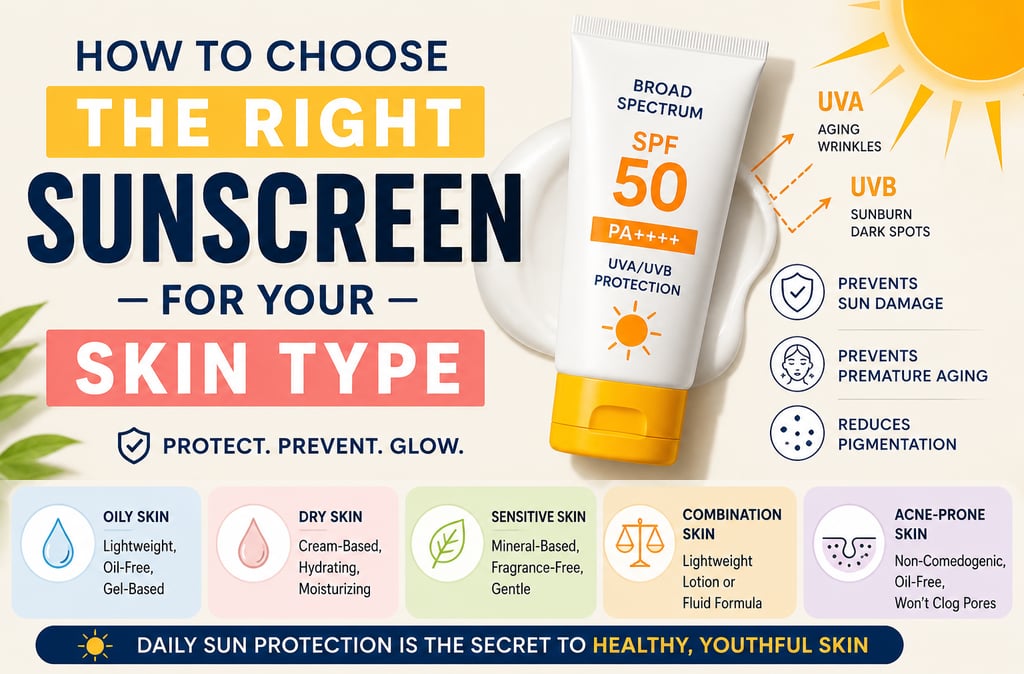
UVA Rays: Cause premature aging, wrinkles, and pigmentation.
UVB Rays: Cause sunburn and increase the risk of skin cancer.
Daily sunscreen helps to:
Prevent sunburn
Reduce tanning and pigmentation
Delay signs of aging
Protect collagen and skin elasticity
Lower the risk of skin cancer
Maintain an even skin tone
Even on cloudy days, UV rays can reach your skin, making sunscreen an everyday necessity.
Understanding SPF and PA Rating
When shopping for sunscreen, you'll often notice SPF and PA ratings.
SPF (Sun Protection Factor)
SPF measures protection against UVB rays.
SPF 30 blocks about 97% of UVB rays.
SPF 50 blocks about 98%.
SPF 50+ provides slightly higher protection for people with prolonged sun exposure.
Higher SPF does not mean you can skip reapplication.
PA Rating
PA indicates protection against UVA rays.
PA+
PA++
PA+++
PA++++ (highest protection)
For Indian weather, dermatologists usually recommend SPF 30–50 with PA+++ or PA++++.
How to Choose the Right Sunscreen for Your Skin Type
Choosing sunscreen according to your skin type ensures better comfort, effectiveness, and long-term compliance.
1. Sunscreen for Oily Skin
People with oily skin often avoid sunscreen because it feels heavy or causes acne. However, the right formulation can actually help control excess oil.
Look for:
Oil-free formula
Gel-based sunscreen
Matte finish
Non-comedogenic label
Lightweight texture
Ingredients like niacinamide and silica help reduce shine while protecting the skin.
Avoid thick cream-based sunscreens that can clog pores.
2. Sunscreen for Dry Skin
Dry skin needs hydration along with sun protection.
Choose products containing:
Hyaluronic Acid
Ceramides
Glycerin
Vitamin E
Squalane
Cream-based sunscreens work better because they lock in moisture while protecting against UV damage.
Avoid alcohol-heavy formulations that may worsen dryness.
3. Sunscreen for Sensitive Skin
Sensitive skin reacts easily to fragrances, alcohol, or harsh chemicals.
The safest options include:
Mineral sunscreen
Zinc Oxide
Titanium Dioxide
Fragrance-free products
Hypoallergenic formulations
These ingredients sit on the skin's surface and reflect UV rays rather than absorbing them.
Patch testing a new sunscreen before regular use is always recommended.
4. Sunscreen for Acne-Prone Skin
Acne-prone skin requires lightweight products that won't clog pores.
Choose sunscreen labeled:
Non-comedogenic
Oil-free
Lightweight gel
Water-based
Ingredients like niacinamide can help reduce redness and inflammation.
Avoid thick oily formulations that may trigger breakouts.
5. Sunscreen for Combination Skin
Combination skin has both oily and dry areas.
A lightweight lotion or fluid sunscreen usually provides balanced hydration without making oily areas greasy.
Hybrid sunscreens often work well because they combine comfort with broad-spectrum protection.
Mineral vs Chemical Sunscreen
Many people are confused about which sunscreen type is better.
Mineral Sunscreen
Advantages:
Works immediately after application
Suitable for sensitive skin
Less irritating
Reflects UV rays
Main ingredients:
Zinc Oxide
Titanium Dioxide
Chemical Sunscreen
Advantages:
Lightweight
Easy to blend
No white cast
Ideal under makeup
Common ingredients:
Avobenzone
Octinoxate
Octocrylene
Both types can be effective when used correctly.
How Much Sunscreen Should You Apply?
One of the biggest mistakes is applying too little sunscreen.
Dermatologists recommend:
Two finger lengths for the face and neck
Around one shot glass (30 ml) for the entire body
Apply sunscreen 15–20 minutes before sun exposure.
Reapply every 2 hours, especially if you are sweating, swimming, or spending long periods outdoors.
Common Sunscreen Mistakes
Avoid these common errors:
Applying sunscreen only during summer
Forgetting the neck and ears
Not reapplying throughout the day
Using expired sunscreen
Applying too little product
Skipping sunscreen indoors near windows
Assuming makeup with SPF provides enough protection
Consistent application is more important than simply buying a high-SPF product.
Ingredients to Look For
Depending on your skin type, beneficial sunscreen ingredients include:
Zinc Oxide
Titanium Dioxide
Hyaluronic Acid
Ceramides
Niacinamide
Vitamin E
Squalane
These ingredients provide both sun protection and skin nourishment.
Who Should Wear Sunscreen?
Everyone should wear sunscreen, including:
Men
Women
Teenagers
Children (using age-appropriate sunscreen)
People with darker skin tones
Individuals working indoors
People using retinol or exfoliating acids
Daily sunscreen use benefits every skin type regardless of age or complexion.
Frequently Asked Questions (AEO Section)
Which sunscreen is best for oily skin?
A lightweight, oil-free, gel-based sunscreen with SPF 30–50 and PA+++ or PA++++ is usually the best choice.
Can people with acne use sunscreen?
Yes. Choose a non-comedogenic, oil-free sunscreen designed for acne-prone skin.
Is SPF 50 better than SPF 30?
SPF 50 provides slightly more UVB protection than SPF 30, but proper application and regular reapplication matter much more.
Should sunscreen be worn indoors?
Yes. UVA rays can penetrate windows, making daily sunscreen important even indoors.
How often should sunscreen be reapplied?
Every two hours, or more frequently after swimming, sweating, or towel drying.
Final Thoughts
Learning How to Choose the Right Sunscreen for Your Skin Type is an essential step toward healthier skin. The best sunscreen is one that suits your skin type, provides broad-spectrum protection, and is comfortable enough to wear every day. Whether you have oily, dry, sensitive, acne-prone, or combination skin, selecting the right formula can help prevent sun damage, premature aging, and pigmentation while keeping your skin healthy year-round.
If you're unsure which sunscreen is right for your skin, consult a qualified dermatologist for personalized advice. Dr. Aliza Zaidi at Dermacore Clinic, Gomti Nagar, Lucknow, recommends choosing a sunscreen based on your skin's individual needs and making it a non-negotiable part of your daily skincare routine.
Dermacore
3/285, Vivek Khand, Near Neelkanth Sweets, Gomti Nagar, Lucknow, 226010-U.P.
☏ 6386858427, 7607999766
✉ support@dermacore.in